

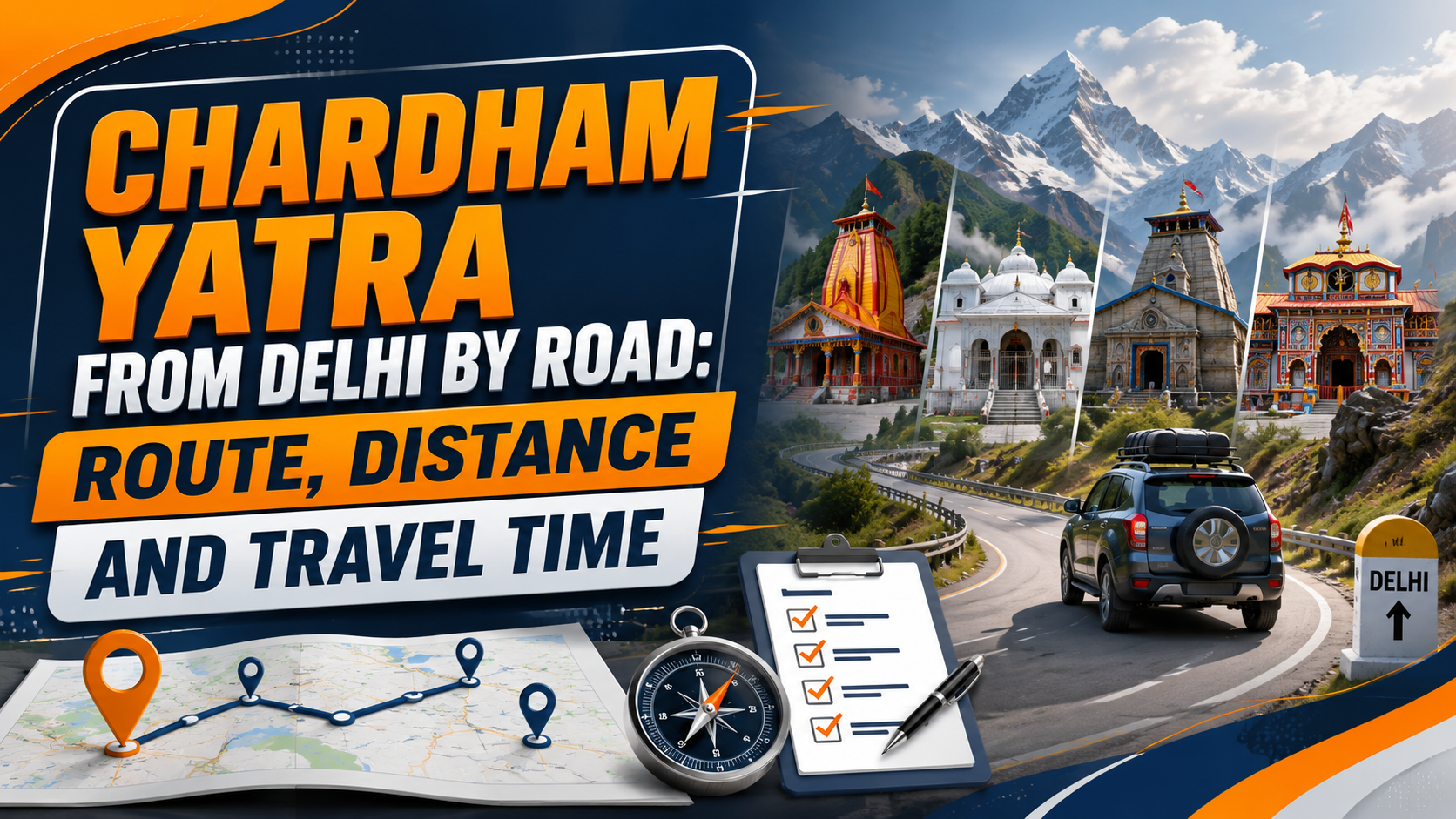
Planning a pilgrimage to Uttarakhand from the national capital is easier when you understand the Chardham Yatra route from Delhi before starting the journey. The Char Dham circuit covers Yamunotri, Gangotri, Kedarnath and Badrinath, with several mountain roads, scenic valleys and important pilgrimage towns along the way. For travelers choosing a road journey, knowing the approximate distances, driving times and overnight stops can make the yatra more comfortable and better organized.
The complete journey from Delhi involves considerably more than simply driving from one temple to another. Mountain roads are slower than highways, and some shrines require trekking or local transport after reaching the nearest roadhead. Therefore, a realistic itinerary should allow sufficient time for travel, darshan, rest and changing weather conditions.
Chardham Yatra by Road from Delhi: Overview
The four sacred shrines of Uttarakhand are located in different parts of the Garhwal Himalayas:
- Yamunotri Dham – dedicated to Goddess Yamuna
- Gangotri Dham – dedicated to Goddess Ganga
- Kedarnath Dham – one of the most revered Shiva temples
- Badrinath Dham – dedicated to Lord Vishnu
A typical Chardham Yatra by Road from Delhi begins with Delhi–Haridwar or Delhi–Rishikesh and then proceeds into the Himalayan region. The commonly followed sequence is Yamunotri, Gangotri, Kedarnath and Badrinath.
The road portion is substantial, but the journey itself is part of the pilgrimage. Travelers pass through forests, river valleys, mountain villages and important destinations such as Barkot, Uttarkashi, Guptkashi, Sonprayag, Rudraprayag and Joshimath.
Chardham Yatra Route from Delhi: Main Road Route
Delhi to Haridwar and Rishikesh
The first section is comparatively straightforward, using major highways toward Haridwar and Rishikesh. Delhi to Haridwar is roughly 210–230 km, while Rishikesh is slightly farther depending on the exact starting point.
Travel time is generally around 5–7 hours, depending on traffic, breaks and road conditions. Many pilgrims use Haridwar or Rishikesh as the starting overnight halt before entering the mountains.
Rishikesh to Barkot and Yamunotri
From Rishikesh, the route continues toward Narendranagar, Chamba, Tehri and Dharasu before reaching Barkot. Barkot is an important base for the Yamunotri leg.
The road distance from Rishikesh to Barkot is approximately 210–230 km, and driving can take around 7–9 hours because of winding mountain roads.
Yamunotri is not directly accessible by road. Vehicles generally go up to Janki Chatti, from where pilgrims undertake the trek to Yamunotri Temple. The trek is roughly 5–6 km one way, although the actual experience may vary depending on the route, weather and local arrangements.
Barkot to Uttarkashi and Gangotri
After completing Yamunotri, pilgrims generally travel toward Uttarkashi and then proceed to Gangotri. Barkot to Uttarkashi is around 100 km, while Uttarkashi to Gangotri is approximately 95 km.
The combined journey requires several hours because of the terrain. Uttarkashi is an important stop for rest, supplies and acclimatization before continuing toward Gangotri.
Gangotri is one of the four Char Dham temples and is situated at an elevation of approximately 3,100 metres. Travelers should keep enough time for darshan and the return journey rather than attempting to rush through this section.
Gangotri to Guptkashi or Kedarnath Region
The next major section of the Chardham Yatra route from Delhi takes pilgrims toward the Kedarnath region. The route generally passes through Uttarkashi, Dharasu, Tehri and onward toward Rudraprayag before reaching areas such as Guptkashi or Sonprayag.
This is a long mountain journey, so an overnight stop may be necessary depending on the itinerary. Road distances and travel times can vary considerably because of traffic, weather, roadwork and seasonal conditions.
Kedarnath is not accessible by road directly. Vehicles generally travel to Sonprayag, with local arrangements taking pilgrims toward Gaurikund, followed by the trek to Kedarnath. The trek is considerably longer than the Yamunotri trek, so travelers should plan a dedicated stay for the Kedarnath visit.
Kedarnath to Badrinath
After Kedarnath, the journey continues through the Garhwal region toward Badrinath. A common route passes through places such as Guptkashi, Rudraprayag, Karnaprayag and Joshimath before reaching Badrinath.
This section offers some of the most scenic views of the yatra, with mountain ranges and river valleys accompanying the road journey.
Badrinath is located at a high altitude, so travelers should avoid unnecessarily tight schedules. After darshan, the return route generally continues through Joshimath, Pipalkoti, Karnaprayag and Rudraprayag before eventually heading toward Rishikesh and Delhi.
Approximate Chardham Yatra Distance from Delhi
The total road distance depends on the exact itinerary, accommodation stops, detours and the roadhead selected for Yamunotri and Kedarnath. A complete Delhi-to-Delhi Chardham journey commonly covers around 1,700–2,000 km or more by road.
| Route Section | Approx. Distance | Approx. Driving Time |
|---|---|---|
| Delhi to Haridwar | 210–230 km | 5–7 hours |
| Rishikesh to Barkot | 210–230 km | 7–9 hours |
| Barkot to Yamunotri roadhead | Varies | Several hours |
| Barkot to Uttarkashi | Around 100 km | 4–5 hours |
| Uttarkashi to Gangotri | Around 95 km | 4–5 hours |
| Kedarnath region | Varies | Road + trek |
| Rudraprayag to Badrinath | Around 160 km | 6–8 hours |
| Badrinath to Rishikesh | Around 290–300 km | 9–11 hours |
| Rishikesh to Delhi | Around 230 km | 5–7 hours |
These figures are estimates rather than fixed travel times. Mountain journeys should always include additional time for meals, traffic, weather and unexpected road delays.
How Many Days Are Needed for Chardham Yatra from Delhi?
A comfortable Delhi-to-Delhi Chardham pilgrimage generally requires 10–14 days, depending on the itinerary and number of overnight halts. A shorter schedule can feel rushed because Yamunotri and Kedarnath involve trekking, while the long mountain drives require adequate rest.
A well-planned itinerary should include:
- Overnight halts at suitable mountain towns
- Dedicated time for Yamunotri and Kedarnath
- Buffer time for weather and road conditions
- Comfortable travel between major dhams
- Adequate rest before and after trekking sections
For travelers looking for a structured itinerary, Chardham Yatra from Delhi by road can be a useful option for planning the complete pilgrimage.
Best Time for Chardham Yatra by Road from Delhi
The Char Dham temples are generally visited during the pilgrimage season when the shrines are open and road conditions are comparatively suitable. May to June is popular, while September to October can also offer favorable conditions after the peak monsoon period.
July and August can bring heavy rainfall in Uttarakhand. Landslides, road closures and travel delays are possible during periods of intense rain. Before beginning the journey, travelers should check current weather and road conditions and remain flexible with their schedule.
Important Tips for the Delhi Chardham Road Journey
Keep Extra Travel Time
Mountain driving is slower than driving on plains. Do not calculate the itinerary solely on map distance.
Pack for Changing Weather
Carry warm layers, comfortable walking shoes, rain protection and essential personal items. Temperatures can change significantly as you gain altitude.
Prepare for Trekking
Yamunotri and Kedarnath require walking beyond the vehicle-accessible points. Comfortable footwear and appropriate pacing are important.
Avoid Overcrowding the Schedule
A pilgrimage is more enjoyable when there is enough time for darshan and rest. A schedule with realistic driving hours is preferable to one that tries to cover too much every day.
FAQs About Chardham Yatra Route from Delhi
What is the best route for Chardham Yatra from Delhi?
A commonly followed route is Delhi–Haridwar/Rishikesh–Barkot–Yamunotri–Uttarkashi–Gangotri–Kedarnath region–Rudraprayag–Badrinath–Rishikesh–Delhi. The exact route can change according to accommodation and road conditions.
How far is Chardham from Delhi by road?
A complete Delhi-to-Delhi Chardham trip can cover approximately 1,700–2,000 km or more, depending on the itinerary, roadheads, local travel and detours.
Can I reach all four Dhams by car?
No. Vehicles cannot reach the temples of Yamunotri and Kedarnath directly. Travelers need to continue on foot or use locally available options from the respective roadheads.
How long does Chardham Yatra take from Delhi?
A comfortable trip generally takes around 10–14 days. The ideal duration depends on the route, trekking requirements, number of overnight stops and travel pace.
Understanding the Chardham Yatra route from Delhi helps pilgrims prepare for the long distances, mountain driving and trekking involved in this sacred journey. From Delhi and Haridwar to Yamunotri, Gangotri, Kedarnath and Badrinath, every stage requires thoughtful planning and sufficient time.
For a smoother Chardham Yatra by Road from Delhi, choose a realistic itinerary, allow extra time for mountain roads, prepare for changing weather and keep adequate rest between major pilgrimage stops. With proper planning, the journey can become not only a religious pilgrimage but also a memorable experience through the spectacular landscapes of Uttarakhand.
